UGC Fresh Data Program Integration: How Google's Pipeline Differs from the Indexing API
Google just published the technical eligibility and freshness requirements for its UGC Fresh Data Program, a dedicated ingestion pipeline for large user generated content platforms. The surprising part is not that it exists. It is that Google built it as a third path, separate from ordinary crawling and separate from the Indexing API, and still promises nothing about visibility.
TL;DR
- Google now runs three distinct paths into Search for content: ordinary crawling, the Indexing API, and the UGC Fresh Data Program. They are separate pipelines with separate rules.
- The program is selective. Google asks applicants to expect roughly 6 to 8 weeks for a response, and it targets eligible high volume UGC platforms, not every site with comments.
- The freshness bar is concrete: new UGC within minutes, engagement counters updated within 72 hours. Even after you are in, inclusion in Search is not guaranteed.
This guide treats UGC Fresh Data Program integration as an engineering problem: which path your content actually travels, what the eligibility review checks, how to build the event pipeline that hits those freshness windows, and how your structured data should behave either way. The examples use TypeScript and Next.js, because that is the stack I build forum and community products in. If your posts enter the system through a form, our walkthrough on building a Next.js form with Server Actions and Zod shows the validated submission step that everything below hangs off.
The three ingestion paths
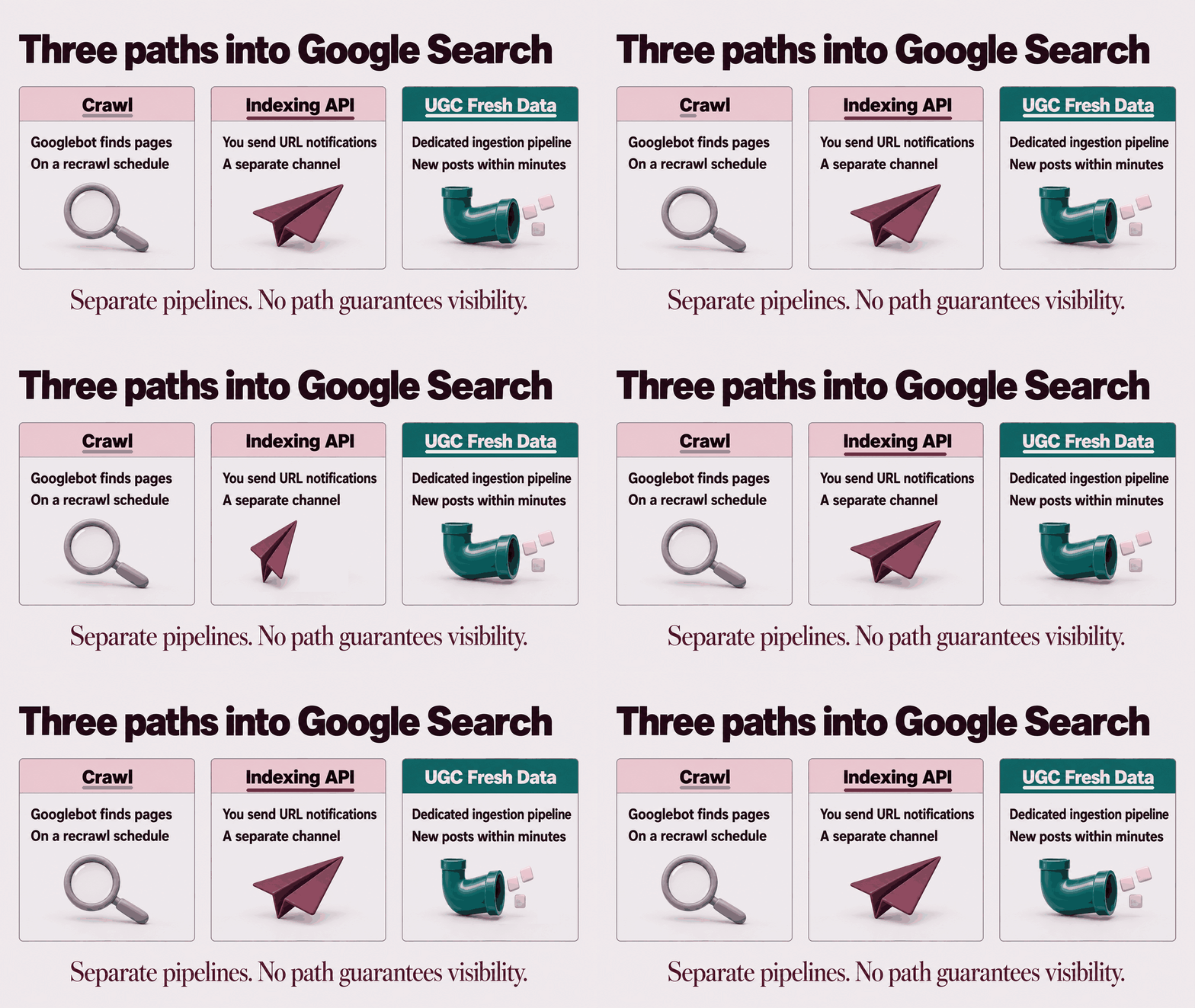
Most teams think of Google indexing as one funnel with a few accelerators bolted on. That model is now wrong. There are three paths, and Google describes the UGC Fresh Data Program as distinct from both of the others.
- Ordinary crawling. Googlebot discovers and recrawls your pages on its own schedule. You influence it with sitemaps, internal links and server health, but you do not control timing.
- The Indexing API. You notify Google about specific URLs. It is a notification channel, not a content channel, and it is not the UGC program.
- The UGC Fresh Data Program. A dedicated ingestion pipeline for eligible high volume UGC platforms, designed around freshness rather than normal recrawl latency.
The practical consequence: a platform that wants the third path still needs the first one to work perfectly. Your pages remain the canonical, crawlable source of truth. The fresh data pipeline is an extra lane for speed, not a replacement for being a well built website.
Here is how I would encode that routing decision in code, so nobody on the team quietly assumes the fast lane exists:
type IngestionPath = "crawl" | "indexing-api" | "ugc-fresh-data";

interface PlatformProfile {
  acceptedIntoUgcProgram: boolean; // only true after Google approves the application
  usesIndexingApiForThisContent: boolean;
}

export function ingestionPathsFor(profile: PlatformProfile): IngestionPath[] {
  // Crawling is never optional: it is the baseline every other path assumes.
  const paths: IngestionPath[] = ["crawl"];
  if (profile.usesIndexingApiForThisContent) paths.push("indexing-api");
  if (profile.acceptedIntoUgcProgram) paths.push("ugc-fresh-data");
  return paths;
}

// A community product before acceptance:
console.log(ingestionPathsFor({ acceptedIntoUgcProgram: false, usesIndexingApiForThisContent: false }));
// -> [ 'crawl' ]
Boring on purpose. The function makes one point explicit in your codebase: crawl is always in the list.
Technical eligibility requirements
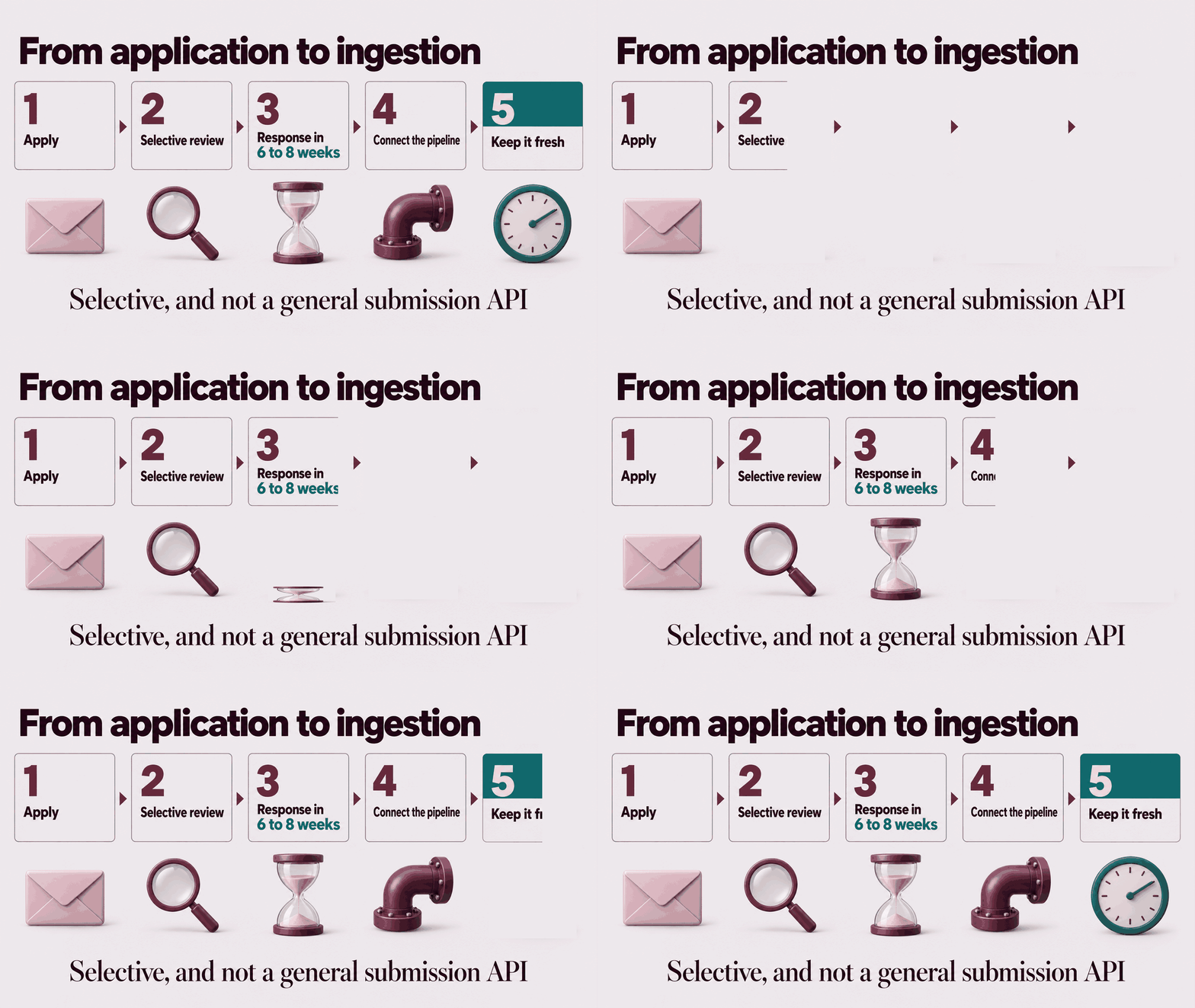
Google's documentation and the independent coverage agree on the shape of the eligibility process: it is selective, it starts with an application, and it is not a general purpose submission API. Google tells applicants to expect roughly 6 to 8 weeks for an application response.
That timeline matters for planning. If your growth plan assumes fresh data ingestion next sprint, it is already late. Treat the application as a parallel track and keep shipping improvements to the crawl path while you wait.
What can you do before applying? Make sure the platform already behaves the way a fresh data partner would have to behave. A small readiness check against your own event log answers that. The thresholds below are illustrative engineering targets, not Google's criteria:
interface PostEvent {
  postId: string;
  createdAt: number;   // ms since epoch, when the user hit submit
  publishedAt: number; // ms since epoch, when the canonical URL returned 200
}

const MINUTE = 60_000;

export function publishLagReport(events: PostEvent[]) {
  const lags = events.map((e) => e.publishedAt - e.createdAt).sort((a, b) => a - b);
  const p95 = lags[Math.floor(lags.length * 0.95)] ?? 0;
  return {
    posts: events.length,
    p95LagMinutes: +(p95 / MINUTE).toFixed(1),
    // Internal target: a post is live on its own URL in under 2 minutes at p95.
    readyForMinuteLevelFreshness: p95 < 2 * MINUTE,
  };
}
If your own pages take twenty minutes to become reachable after a user submits, no external pipeline will make you look fresh. Fix the internal lag first.
Freshness and interaction updates
This is the part of the published requirements I find most useful, because it gives two concrete windows. Google recommends sending new UGC within minutes, and updating engagement counters within 72 hours. Those numbers tell you the program is built around freshness, not around the latency of a normal recrawl.
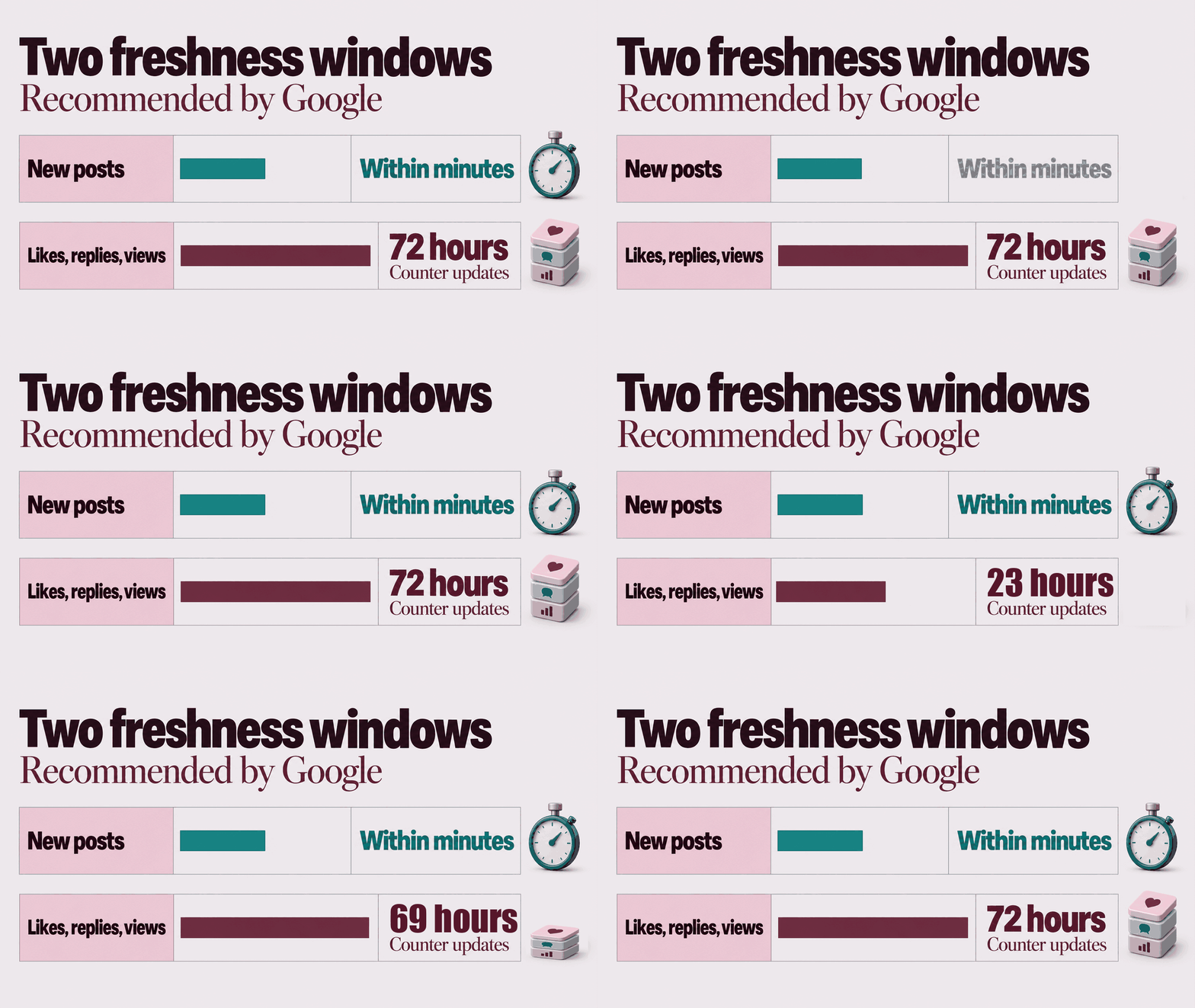
Two windows means two lanes in your pipeline. New content is latency sensitive, so it goes out on an event the moment a post is published. Counters change constantly, so they get batched and flushed well inside the 72 hour window instead of firing on every like.
type Outbound =
  | { kind: "new-post"; postId: string; url: string }
  | { kind: "counters"; postId: string; replies: number; likes: number };

const HOUR = 3_600_000;
const COUNTER_FLUSH_EVERY = 6 * HOUR; // well inside the 72 hour window

const pendingCounters = new Map<string, Extract<Outbound, { kind: "counters" }>>();

export async function onPostPublished(postId: string, url: string, send: (m: Outbound) => Promise<void>) {
  // Lane 1: new content leaves immediately.
  await send({ kind: "new-post", postId, url });
}

export function onEngagementChanged(postId: string, replies: number, likes: number) {
  // Lane 2: keep only the latest counters per post; the flusher sends them in batches.
  pendingCounters.set(postId, { kind: "counters", postId, replies, likes });
}

export async function flushCounters(send: (m: Outbound) => Promise<void>) {
  for (const update of pendingCounters.values()) await send(update);
  pendingCounters.clear();
}

setInterval(() => flushCounters(async (m) => console.log("send", m)), COUNTER_FLUSH_EVERY);
The send function is deliberately abstract. The transport for accepted partners is defined by Google's program documentation; I am not going to guess at an API shape I have not integrated. What you control today is the architecture: an outbox with two lanes, keyed by post id, that you can point at whatever transport you are given.
Structured data integration for ordinary sites
Even if you never apply, the program is a strong hint about what Google values for UGC: stable URLs, accurate counters and content that is visible fast. The markup on your pages should carry the same truth your pipeline would send. A schema.org DiscussionForumPosting block in JSON-LD, generated from the same record that renders the page, keeps the two from drifting apart:
// app/threads/[id]/page.tsx
import { getThread } from "@/lib/threads";

export default async function ThreadPage({ params }: { params: Promise<{ id: string }> }) {
  const { id } = await params;
  const thread = await getThread(id);

  const jsonLd = {
    "@context": "https://schema.org",
    "@type": "DiscussionForumPosting",
    headline: thread.title,
    text: thread.body,
    url: `https://forum.example.com/threads/${thread.id}`,
    datePublished: thread.createdAtIso,
    author: { "@type": "Person", name: thread.authorName },
    interactionStatistic: [
      { "@type": "InteractionCounter", interactionType: "https://schema.org/CommentAction", userInteractionCount: thread.replyCount },
      { "@type": "InteractionCounter", interactionType: "https://schema.org/LikeAction", userInteractionCount: thread.likeCount },
    ],
  };

  return (
    <article>
      <script type="application/ld+json" dangerouslySetInnerHTML={{ __html: JSON.stringify(jsonLd) }} />
      <h1>{thread.title}</h1>
      <p>{thread.body}</p>
      <footer>{thread.replyCount} replies · {thread.likeCount} likes</footer>
    </article>
  );
}
The rule I follow: the counter in the markup and the counter in the footer come from one field. When they disagree, you are telling a crawler one thing and a reader another. If you are building this kind of community product on Next.js and want a second pair of eyes on the architecture, that is the work behind our Next.js for AI products service.
Why inclusion is still not guaranteed
The line in Google's documentation that every product manager should read twice: participation does not guarantee Search visibility. The program changes how fast your content can reach Google. It does not change whether Google decides that content deserves to be shown.
So the pipeline is necessary, not sufficient. Quality, duplication, spam handling and page experience still decide ranking. A platform that pushes thin or duplicated threads faster has simply found a quicker way to show Google its weak pages.
My take, as an opinion rather than a finding: the teams that will benefit most are the ones whose crawl path is already excellent. For them, the fresh data lane removes the last bit of latency. For everyone else, the 6 to 8 weeks of review is better spent on the readiness work in the checklist below.
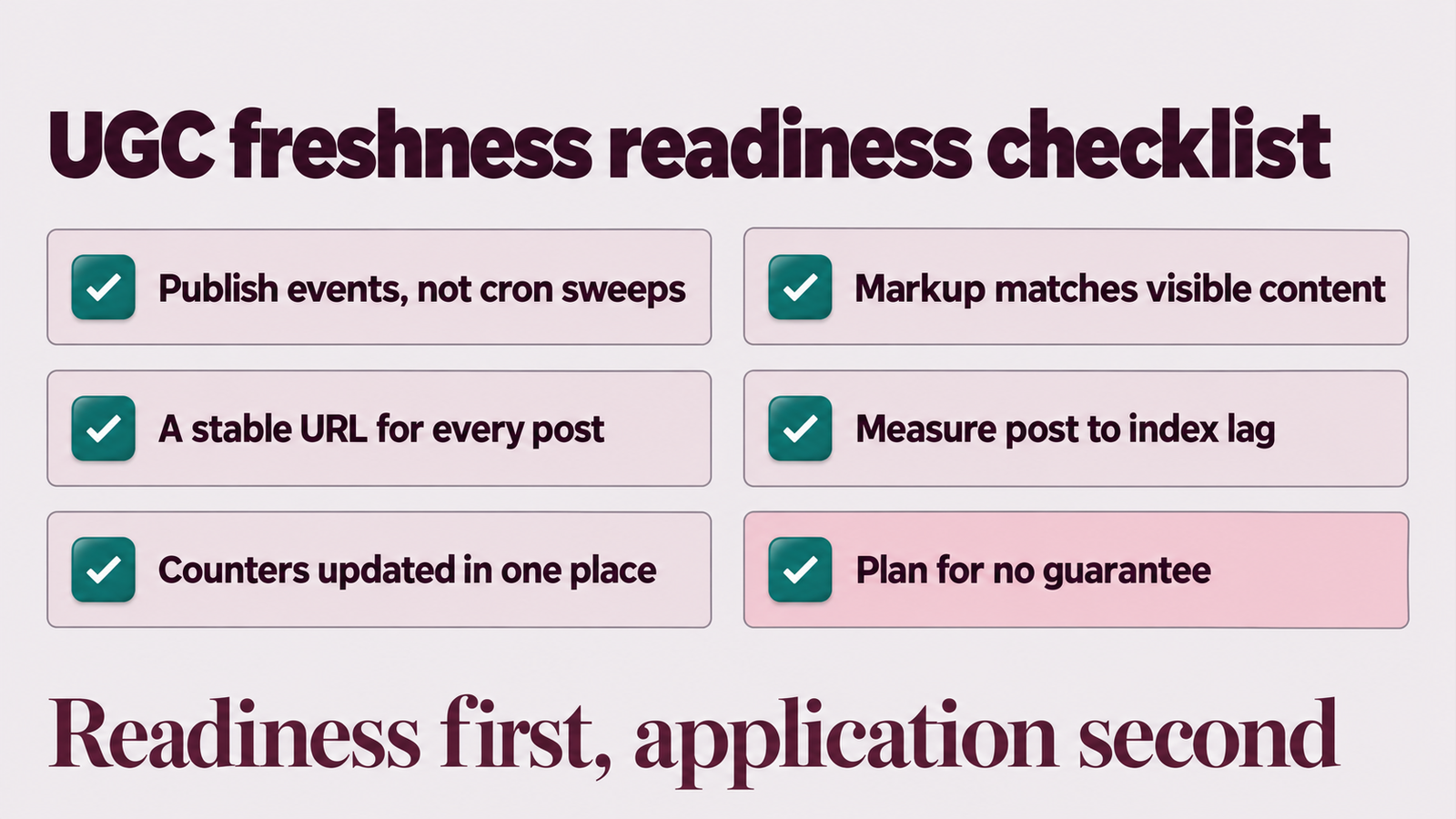
| Situation | What to do |
|---|---|
| Small community, steady posting | Perfect the crawl path: sitemaps, internal links, fast canonical URLs |
| Time sensitive URLs you already notify Google about | Keep the Indexing API where it fits; it is a separate path |
| High volume UGC platform with minute level freshness | Apply to the program and build the two lane outbox now |
| Accepted partner | Send new posts within minutes, counters within 72 hours, and keep pages canonical |
FAQ
What changed in ugc fresh data program integration structured data?
Google documented a dedicated ingestion path for eligible high volume UGC platforms, with published freshness targets: new content within minutes and engagement counters within 72 hours. It is separate from both crawling and the Indexing API. Your structured data still matters, because your pages remain the canonical source that crawling reads.
How should teams adopt ugc fresh data program integration structured data?
Start with readiness, not the application. Measure how long a post takes to become reachable on its own URL, generate markup and visible counters from one record, and build an outbox with a fast lane for new posts and a batched lane for counters. Then apply, and expect roughly 6 to 8 weeks for a response.
Does the UGC Fresh Data Program replace the Indexing API?
No. Google describes them as separate. The Indexing API notifies Google about URLs; the UGC program is its own ingestion pipeline with its own eligibility review.
Will joining the program improve my rankings?
Not by itself. Google states that participation does not guarantee Search visibility. It shortens the path, not the judgment.
Related reading: Next.js Server Actions vs tRPC: which one to pick for your AI app and Next.js Security Hardening: Middleware, Server Actions, and CSP Patterns That Hold Up.
If you are planning a UGC platform that has to be fast for users and for search engines, I help teams design exactly this pipeline; see how I build production Next.js products for how that engagement works.
Comments
Join the discussionNo comments yet. Be the first to comment.